We all agree culture is important. We all agree that good culture should lead to better results. And yet, many struggle to actually describe what their culture is. How then, can it be used as a driver of high-performance if we don't understand what it is that helps us do our best work together?
Why Make Culture Tangible?
Too many companies believe they invest in culture, have a handle on culture, and understand their culture, with an understanding that it will lead to high-performing teams. But it does not. Why? Because too often we focus on culture at a surface level.
Culture is how we work.
Not how we feel about work.
How work makes us feel. Important, but a symptom of culture rather than culture itself.
Good eNPS scores can mask real operational dysfunction. Teams can feel good and still not be able to execute.
Benefits, perks, and socials are downstream of culture. Treating them as culture itself is a category error.
That is exactly why our focus at Open Org is about helping people and leadership teams to design and manage culture in a much more transparent, tangible way.
The Culture OS Framework
The result of exposure to dozens of well-known frameworks and diagnostics over the years, combined with a background and belief in product management, and how those principles can be better applied to the people and culture realm.
With a roadmap, diagnostics, prioritisation, and iterative improvement cycles. Treat it like a living system, not a one-off initiative.
Values are just one component. Culture can and should be understood and managed at an operational level across many dimensions.
The unit of analysis is behaviour and process. The observable, changeable mechanics of how your team operates day to day.
The Framework in Detail
Breaking culture into its component parts makes it possible to diagnose, prioritise, and act.
The Culture Management Loop
Breaking down culture into components is just the first step. How you design and manage those components is another important element. Click each step on the loop to explore.
You need a way of building a view of what's healthy, and what's harming you right now. Use a structured diagnostic tool to generate your baseline across all culture components. The Open Org Culture Heatmap is a great starting point: it helps you score each area and surface where the real problems are hiding.
Step 03 In Depth
On the surface there are often one or two obvious causes. But dig deeper, and you'll often connect the problem to things you didn't consider. Too many teams rush to fix the obvious problem, wasting time, energy and resources. There are a couple of tools we recommend.
Start with the problem. Ask "why" five times in sequence. Each answer becomes the input to the next "why." You'll nearly always arrive at a root cause you didn't expect at the start.
Miro template →Maps all potential causes of a problem across multiple dimensions simultaneously. Particularly powerful for complex, multi-factor culture issues where the cause isn't linear.
Miro template →Step 04 In Depth
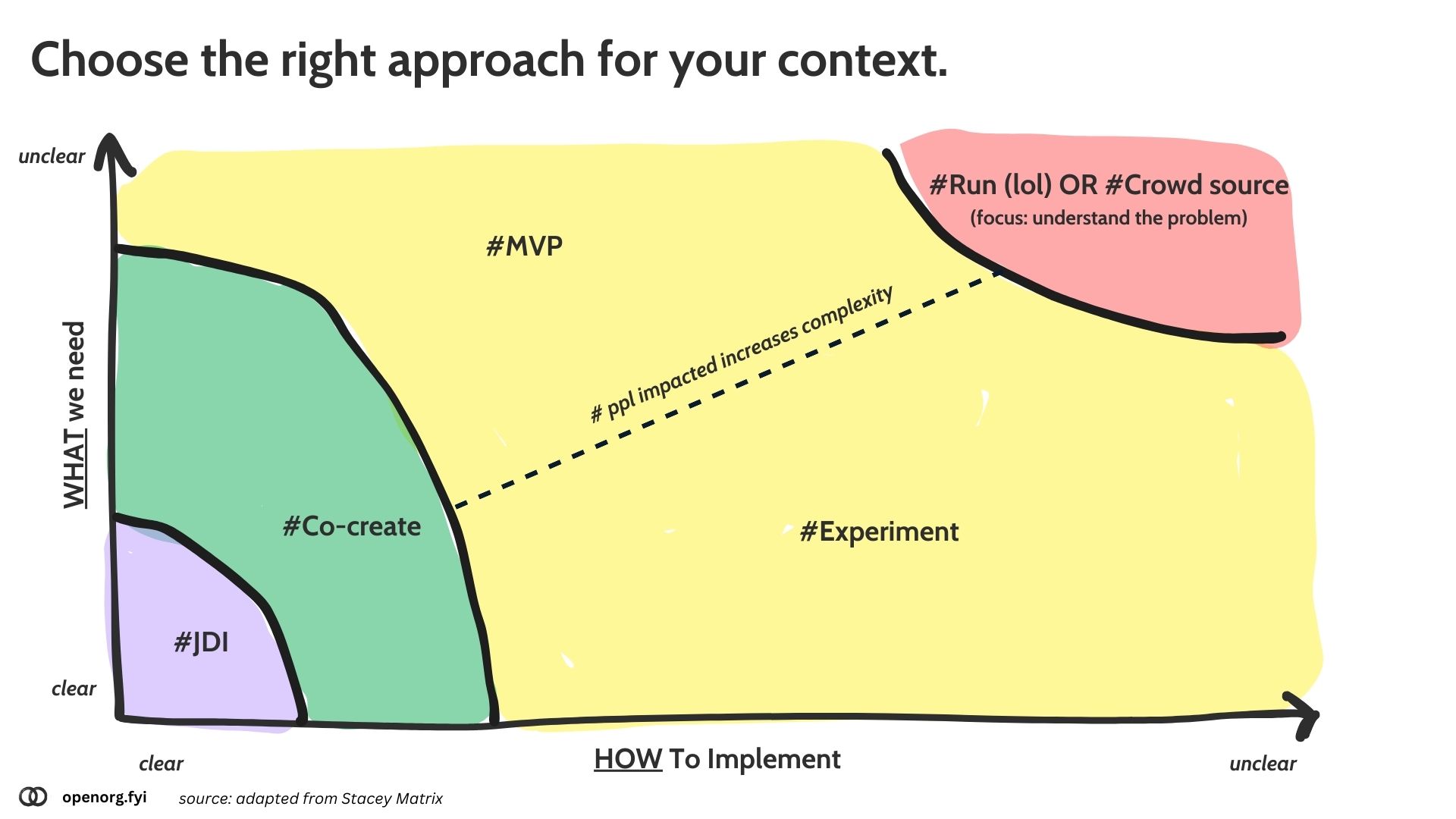
Once you've identified what's actually causing your problem, you need to work on a solution. But what's the right way to fix it? Co-creation is powerful, but it's not the right thing every time. Sometimes you need to just do it. And often you might need to go back to the drawing board to better understand the problem you're trying to solve.
We use an adapted version of the Stacey Matrix to help determine the best approach based on the clarity of what you need and how to implement it.
Step 06 In Depth
Once you've done the thing, there's one more step that many teams fail to do. Closing the loop properly involves a few things when done well.
Confirmation of changes made. You should think about:
How do you continue to monitor health here so you have an early-warning system to understand impact in the future?
Optional, but powerful. Share with the business exactly what you are working on now, next, and why. Open Roadmaps help other teams understand your workload, why you are or are not working on something, and how you prioritise and make decisions. Sharing your roadmap publicly is an incredible employer brand builder too.
Finally...
Part of the challenge most people teams face is working out which fires to tackle, and which to let burn a little longer. You can't fix everything, all at once. Aside from where problem areas seem most concentrated, also consider two things.
Consider which culture problems are most likely to positively impact or support current business priorities. Culture fixes that unlock business outcomes are the ones most worth fighting for first.
Do what you can to quantify just how much these problems are causing harm in financial terms. This often speaks the same language as exec teams, and is sometimes the best way to influence decision-making and reframe culture from being about vibes to being about business performance.
Useful Resources
A self-serve diagnostic tool to build a holistic view of which areas of your culture are healthy or harmful. Run it individually or adapt for org-wide use.
Access 1000's of diagnostics, templates and content like this built just for people teams in scaling orgs.
We support around 10 people teams at a time on tangible culture design and people roadmap execution. Read more here.